Where the mountains turn lunar: A journey through Lahaul-Spiti

This article appeared on Deccan Herald on the 16th of August, 2026. You can check the original article here.
The Lahaul–Spiti circuit is not merely a road trip, it is a passage into a world where man is a reluctant guest, dwarfed by stark ridges, snow-shrouded passes, and monasteries that cling to cliffs as though defying gravity.
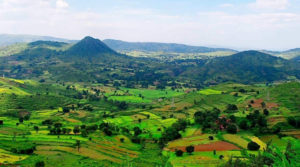
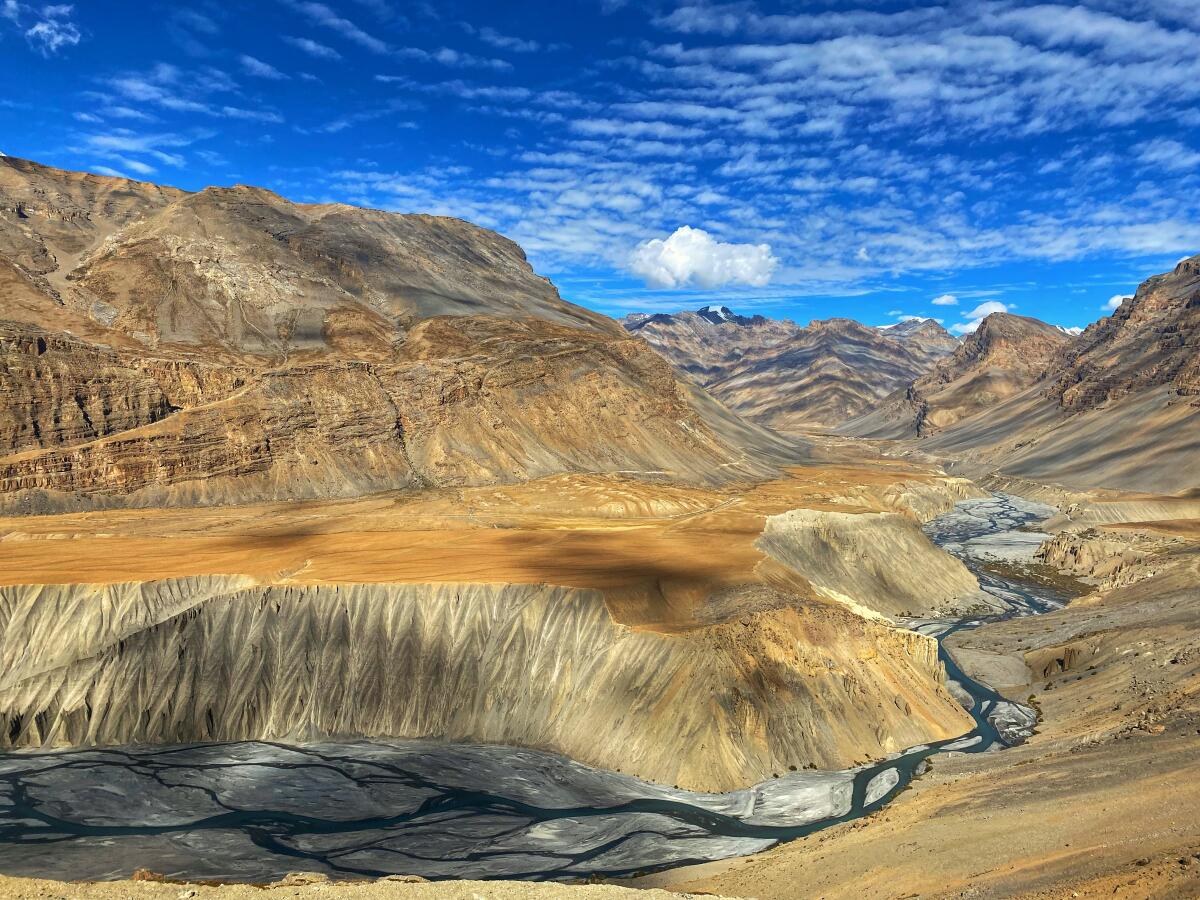
High in the Trans-Himalayas, beyond the apple orchards of Thanedar and the gentler valleys of Himachal Pradesh, lies a landscape that feels more lunar than earthly.
The Lahaul–Spiti circuit is not merely a road trip; it is a passage into a world where man is a reluctant guest, dwarfed by stark ridges, snow-shrouded passes, and monasteries that cling to cliffs as though defying gravity. During our six-day, 700-kilometre loop through Spiti, what we found was not simply another Himalayan journey but a surreal adventure into an ancient, mystical land.
The early stretch lulled us with familiar Sutlej valley scenery before the road climbed into something different altogether. The hillsides sharpened, habitation thinned, and the last patches of green gave way to raw stone. At Khab, a small village, the icy torrent of the Spiti river burst from a gorge to meet the muddy flow of the Sutlej, a symbolic gateway into the valley. Beyond it, the world shifted completely. The road twisted upwards through a desolate wilderness where villages looked like fragile oases of life. Across the valley, the hamlet of Leo glowed in the last light of day, its green and gold fields shining like a defiant splash of colour against a backdrop of barren slopes.
Into the world of monasteries
Tabo was our first halt and an initiation into Spiti’s cultural heart. The monastery here, founded in 996 AD, is the oldest continuously functioning gompa in India. Its thick mud walls enclose nine temples and stupas. Inside, murals and thangkas glowed in the flicker of butter lamps, their artistry so refined that scholars call Tabo the “Ajanta of the Himalayas.”
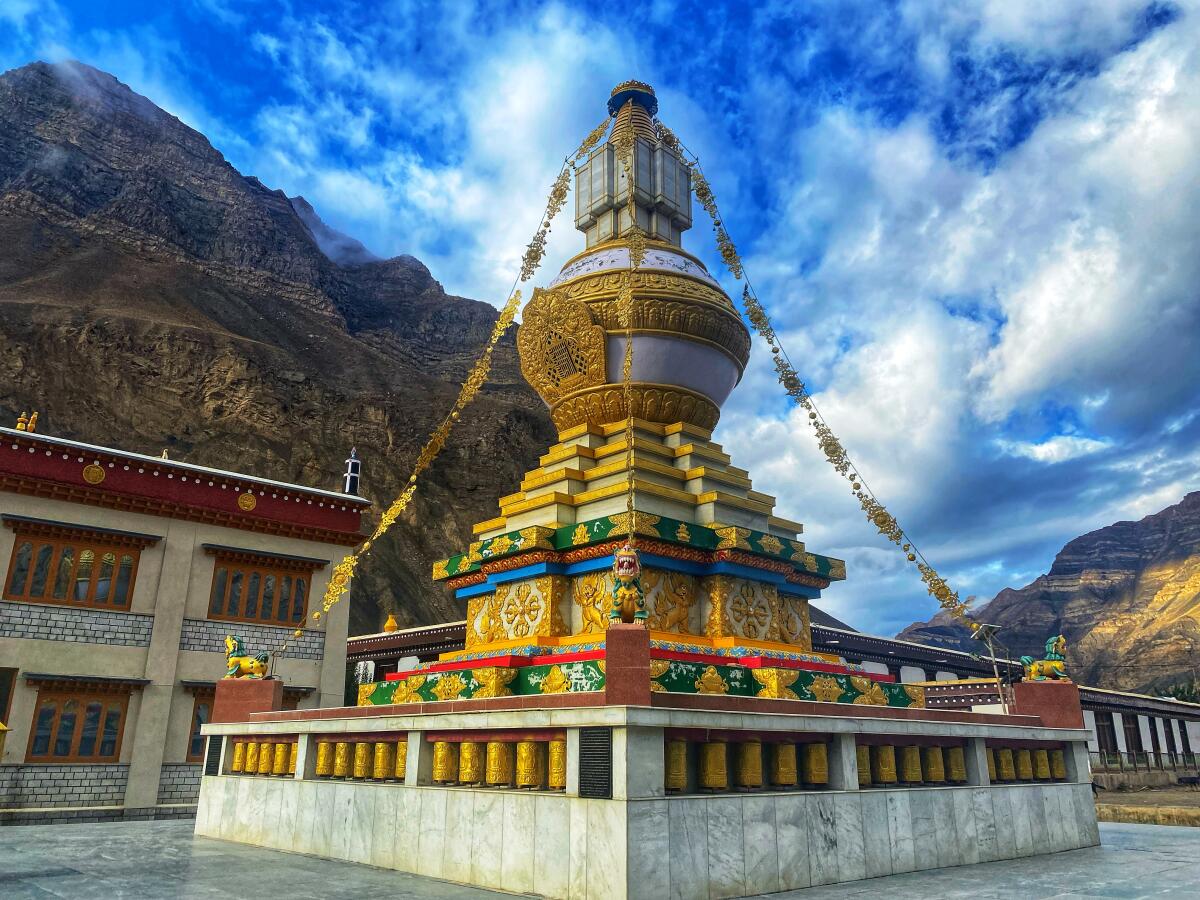
A short climb above the village led us to meditation caves cut into the cliffside. Monks once sealed themselves here in grim pursuit of transcendence, sitting motionless without food or water until the body gave way to the spirit. From the cave entrances, we could view the Spiti river glittering far below, framed by jagged ridges carved by wind into eerie sculptures.
A little further on, Dhangkar Monastery appeared as something conjured out of a fantasy novel. Perched precariously at around 4,000 metres on a cliff overlooking the Spiti–Pin confluence, its whitewashed walls seemed to grow out of the mountainside. Behind it rose a backdrop of striated slopes, like the fossilised ribs of a whale. Inside, rickety staircases led us through low, dim chambers hung with thangkas, before we emerged onto terraces with views that made the monastery feel ethereal. If Tabo was venerable, Dhangkar was sheer theatre.
Buddha, bharals and more
Kaza, the valley’s largest town, became our base. Modest in appearance, with mud-walled houses and willows fringing the river, it was also a gateway to the high plateau where Spiti reveals its curious blend of whimsy and starkness.
A little further from Kaza, we came across Hikkim where we found the ruins of a monastery abandoned after an earthquake and water shortages and its broken walls reminiscent of Machu Picchu. Nearby stood the world’s highest post office at 4,440 metres, a single-room building shaped like a red pillar box with a cheerful postmaster who collected postcards from tourists who seemed more interested in the novelty than the certainty of delivery. I added my own card to the pile, amused at the unlikely prospect of sending a letter from such a remote place.
Our next stop was Komic Monastery, where a Maitreya Buddha presided over its sanctum and a small museum filled with ceremonial masks, costumes, and everyday objects that spoke of Spiti’s resilience. At Langza, a colossal Buddha gazed serenely over the mountains.
The statue felt garish, too modern, and jarring against the timeless landscape. But just above, at Lara’s Café, a bowl of steaming thenthuk — hand-pulled noodle soup fragrant with garlic — and a tangy cup of sea buckthorn tea, brewed from Spiti’s vivid orange berries, refreshed our spirits. As the sun dipped, we were granted a rare sighting: a herd of thirty bharal, or blue sheep, grazing on the rocky slopes.
For the brave
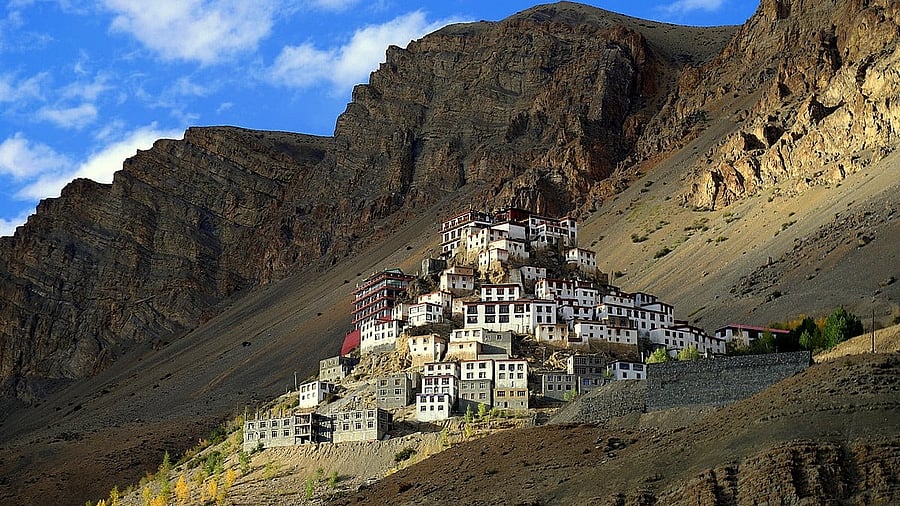
Driving north from Kaza, we came upon the Chicham Bridge, an engineering marvel suspended at 4,145 metres. Spanning a gorge 300 metres deep, it offered dizzying views of a stream threading far below. Beyond it lay Kibber, a village of neat whitewashed houses with blue windows that looked picture-perfect yet eerily deserted, like a film set abandoned mid-shoot. At about 4,200 metres, it is one of the highest inhabited villages in the world and gateway to the Kibber Wildlife Sanctuary, where the lucky can spot the elusive snow leopard. On our return towards Kaza, we visited Key Monastery, Spiti’s most iconic religious site.
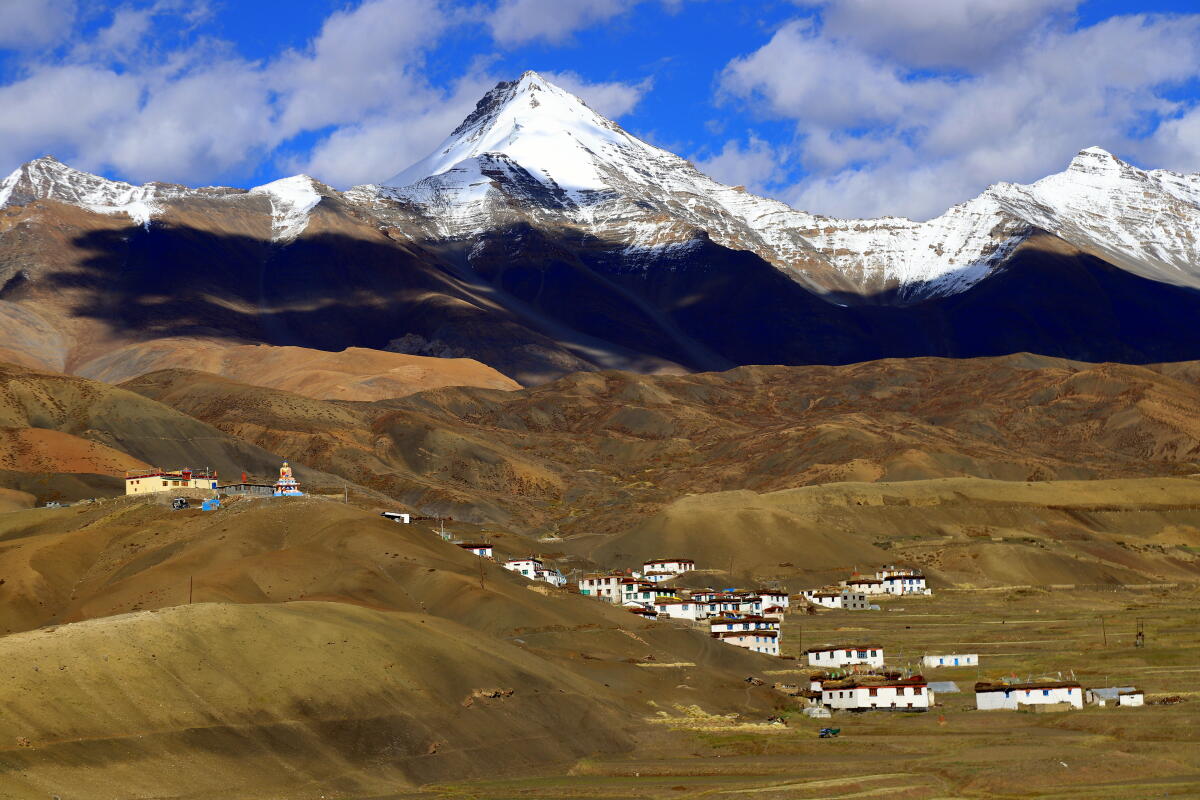
Rising fortress-like above a bend of the Spiti river, its stacked white walls dominated the foreground. Inside, narrow passages and low prayer halls guarded centuries-old murals and manuscripts, while monks’ chants reverberated through corridors filled with incense. Sharing cups of herbal tea with lamas, we felt briefly folded into the monastery’s timeless rhythm.
Leaving Spiti meant confronting its roughest stretch of road. Our car rattled over unmetalled tracks, suffering a puncture en route, before we climbed steadily to Kunzum La at 4,551 metres. The pass felt like a frontier between worlds. Behind us lay the lunar emptiness of Spiti, ahead the greener valleys of Lahaul. Snow peaks ringed the horizon, prayer flags snapped violently in the wind, and a whitewashed shrine dedicated to Kunzum Devi stood as guardian of the pass.
The Lahaul–Spiti circuit is not for the faint-hearted. Roads are rough, distances punishing, and comforts few. Yet those who endure are rewarded with an experience that transcends ordinary travel. It is a land of contradictions — monasteries glowing with centuries of art alongside statues that feel too new, villages that seem both welcoming and abandoned and wildlife that is elusive yet unforgettable. There lies magic within all of this.